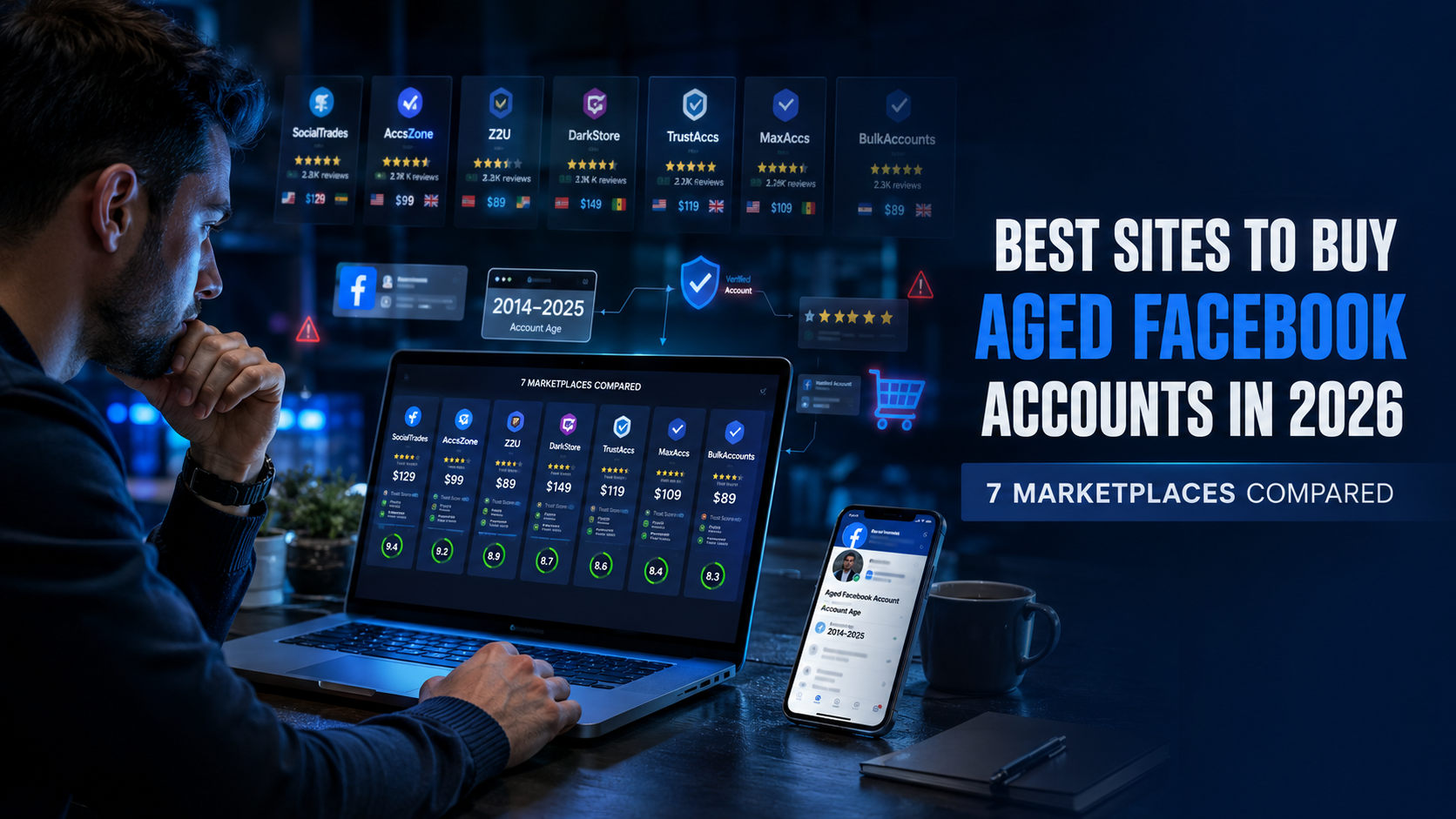
Best Sites to Buy Aged Facebook Accounts in 2026
Account age has become one of the strongest trust signals in Facebook’s enforcement system. Profiles created years ago with consistent login history, organic friend connections, and stable device fingerprints pass automated reviews that newer accounts routinely fail.
This is why aged Facebook accounts have become a distinct product category — separate from freshly registered or bulk-farmed profiles. Buyers are typically advertisers, agencies, and e-commerce operators who need accounts that can access Business Manager, run ads at scale, or operate on Marketplace without triggering early-stage restrictions.
As demand has grown, so has the number of sellers. But quality varies dramatically. A “2015 account” from one provider might be a genuine profile with eight years of activity history. From another, it might be a recently reactivated shell with a backdated creation date and no real engagement trail.
This guide reviews the most reliable sources for buying aged Facebook accounts in 2026 — what each platform offers, how their verification works, and where the risks sit.
What Counts as an Aged Facebook Account
There is no universal definition, but the industry generally uses these tiers:
- 1–2 years: Entry-level aged. Reduces some new-account friction but still triggers scrutiny under heavy use.
- 3–5 years: Mid-tier. Sufficient history for most ad operations and Marketplace access. The most commonly purchased range.
- 5–10+ years: Premium tier. Accounts from 2008–2018 with deep activity logs, friend networks, and established behavioral patterns. Highest trust score, lowest enforcement risk.
Age alone does not determine quality. An account created in 2012 but dormant since 2013 is less valuable than a 2018 account with continuous login activity. The combination of creation date, activity consistency, friend count, and device history is what matters.
You will also see terms like “FB aged accounts” or “aged FB account” used interchangeably with “aged Facebook account” — they mean the same thing. Similarly, providers sometimes list “old Facebook accounts” to describe accounts in the 5+ year tier, while “aged” is used more broadly across all tiers.
1 AccsZone

AccsZone is a large-scale marketplace specializing in aged, verified, and PVA accounts with instant delivery. The platform covers an unusually wide geographic range — aged Facebook accounts are available registered from the US, UK, Europe, Latin America, Asia-Pacific, and the Middle East, making it one of the broadest regional selections in the market.
Accounts are categorized by creation date (with premium listings dating back to 2007–2015), friend count tiers ranging from minimal to 2,000+, and verification method (SMS, email, or both). Most listings include email access, cookies, and profile photos. The platform also offers 2FA-secured accounts for buyers who want an extra layer of login protection.
AccsZone operates a multi-vendor model with a supplier registration program, but maintains more structure than a pure open marketplace. An API is available for resellers and agencies purchasing at volume. Support runs through Telegram with a dedicated channel for updates and promotional codes.
Key Features
- Extensive geographic coverage across 30+ countries
- Aged accounts dating back to 2007–2015 available
- Friend count tiers from minimal to 2,000+
- 2FA-secured and SMS/email verified options
- Cookies and email access included on most listings
- Reseller API for bulk and automated purchasing
- Instant delivery on standard inventory
✓ Pros
- Widest regional selection for aged Facebook accounts
- Deep inventory with high stock availability
- Competitive entry-level pricing starting under $1 for basic accounts
- API access for agencies and resellers
✗ Cons
- Multi-vendor model means quality can vary by supplier
- Premium aged accounts (2007–2015) carry significantly higher pricing
- Support limited to Telegram — no live chat or phone
Average Account Age: 6 months to 15+ years
2 Uproas

Uproas operates as a managed provider of aged Facebook accounts rather than an open marketplace. Every account goes through an internal verification pipeline that checks creation date, login consistency, friend authenticity, and device history before listing.
The platform focuses on accounts suitable for advertising and agency operations. This means accounts are tested against Business Manager onboarding, ad account creation, and pixel deployment before they reach the buyer. Accounts that fail any stage are pulled from inventory.
Uproas also provides post-purchase support — setup guidance, warm-up protocols, and replacement coverage for accounts that encounter enforcement action within the guarantee window. This level of operational support is uncommon among competitors.
Key Features
- Multi-stage verification pipeline for every account
- Pre-tested for Business Manager and ad account access
- Activity-verified profiles with organic friend connections
- Dedicated account manager for onboarding support
- Replacement guarantee with defined coverage period
- Accounts segmented by age tier and intended use case
- Warm-up documentation and best-practice guides included
✓ Pros
- Highest verification standards in the category
- Accounts pre-tested for ad deployment readiness
- Responsive support via Telegram and WhatsApp
- Replacement policy clearly documented
✗ Cons
- Premium pricing reflects verification depth
- Limited availability during peak demand periods
- No self-service bulk ordering for large volumes
Average Account Age: 2 to 10+ years
3 AccsBulk

AccsBulk (accsbulk.com) is a bulk-focused marketplace built for buyers who need volume. The platform carries aged Facebook accounts across multiple regions — US, UK, Europe, Canada, Australia, Latin America, and Asia-Pacific — with listings organized by verification type, friend count, and creation date.
The name describes the model: AccsBulk is designed for agencies, media buyers, and resellers purchasing tens or hundreds of accounts at a time. Listings show real-time stock quantities (often 500–1,400+ units per category) and cumulative sales figures, giving buyers a sense of throughput and demand. Most accounts ship with email access, cookies, and profile photos.
Like AccsZone, AccsBulk offers a reseller API and supplier registration program. The platform also carries Marketplace-enabled accounts and 2FA-secured profiles as distinct product categories, which is useful for buyers with specific operational requirements.
Key Features
- Bulk ordering infrastructure with high stock levels
- Marketplace-enabled accounts as a distinct category
- 2FA-secured and SMS/email verified options
- Regional segmentation across 20+ countries
- Reseller API for automated purchasing
- Cookies, email access, and profile photos included
- Real-time stock and sales volume indicators
✓ Pros
- Purpose-built for volume buyers — strong bulk availability
- Transparent stock counts and historical sales data
- Marketplace-enabled accounts clearly separated
- Competitive pricing at volume
✗ Cons
- Quality control less rigorous than managed providers
- Support via Telegram only
- Individual account verification not guaranteed at scale
Average Account Age: 6 months to 10+ years
4 AccsMarket

AccsMarket (accsmarket.com) is one of the longer-running multi-vendor marketplaces in the social media account space. Sellers list accounts across multiple platforms, and buyers can filter by creation year, friend count, region, and verification status.
The marketplace model means pricing is competitive — multiple sellers compete on the same inventory categories. However, account quality depends heavily on the individual seller. AccsMarket provides a basic dispute system but does not independently verify every listing.
For buyers comfortable evaluating sellers themselves, AccsMarket offers a large selection of aged Facebook accounts by volume. For those who prefer a managed experience, the inconsistency between sellers can be a drawback.
Key Features
- Multi-vendor marketplace with competitive pricing
- Advanced filtering by age, region, friend count
- Seller rating and review system
- Escrow-based payment protection
- Large inventory across multiple platforms
- API access for automated purchasing
✓ Pros
- Large selection of aged accounts by volume
- Competitive pricing driven by multi-seller competition
- Filtering tools make comparison straightforward
✗ Cons
- Quality varies significantly between sellers
- No independent account verification by the platform
- Dispute resolution can be slow
Average Account Age: 6 months to 8+ years (seller-dependent)
5 FameSeller

FameSeller operates as a semi-curated reseller focusing on social media assets. Compared to open marketplaces, it maintains more control over sourcing and distribution of aged accounts.
The platform targets influencers, marketers, and small agencies looking for pre-aged profiles with basic activity history. Accounts are typically bundled with supporting materials such as cookies, recovery information, and login credentials for associated email addresses.
While FameSeller offers moderate quality control, its verification process is less rigorous than enterprise-grade providers. Accounts are spot-checked rather than individually pipeline-tested.
Key Features
- Curated account inventory with quality tiers
- Supporting login materials included (cookies, recovery data)
- Activity-verified profiles
- Basic replacement warranty
- Regional account options (US, UK, EU)
- Simple ordering process
✓ Pros
- Better quality control than open marketplaces
- Straightforward purchasing experience
- Responsive customer support
✗ Cons
- Limited inventory for premium age tiers
- Verification less thorough than managed providers
- Replacement policy terms are narrow
Average Account Age: 8 months to 3 years
6 G2G

G2G started as a gaming marketplace but has expanded into social media accounts, including aged Facebook profiles. The platform connects buyers directly with individual sellers and handles payment processing through its escrow system.
The social media section is growing but remains secondary to the gaming business. Aged Facebook account listings are available but less structured than on dedicated platforms. Buyers should expect to spend more time evaluating individual listings.
G2G’s main advantage is its established escrow and dispute resolution infrastructure, which provides a meaningful layer of payment protection that newer account marketplaces lack.
Key Features
- Established escrow payment system
- Seller verification and rating history
- Growing social media account section
- Multi-platform availability
- Buyer protection policies
✓ Pros
- Trusted escrow system from gaming marketplace heritage
- Seller ratings based on verified transaction history
- Competitive pricing from individual sellers
✗ Cons
- Social media accounts are not the platform’s specialty
- Account quality descriptions can be vague
- No platform-level account verification
Average Account Age: 1 to 5 years
7 PlayerUp

PlayerUp is a middleman marketplace that facilitates account transactions across games and social platforms. The platform holds both payment and account credentials during the transfer, reducing fraud risk for both parties.
Aged Facebook accounts on PlayerUp tend to come from individual sellers rather than professional farming operations. This means the accounts are often genuine personal profiles with organic histories — but supply is inconsistent and inventory is smaller than dedicated account marketplaces.
Key Features
- Middleman escrow service for secure transfers
- Credential holding during transaction
- Seller verification system
- Dispute mediation available
- Individual and bulk listing support
✓ Pros
- Strong fraud protection through middleman model
- Accounts often have organic, genuine histories
- Established platform with long operating history
✗ Cons
- Smaller inventory of aged Facebook accounts
- Supply is inconsistent — availability fluctuates
- Transfer process can take longer than direct-purchase platforms
Average Account Age: 1 to 7 years
Does Account Age Actually Matter for Ads?
Facebook’s enforcement system weighs account history as one of several trust indicators. Older accounts with consistent behavioral patterns — regular logins, organic interactions, stable device associations — receive less automated scrutiny than new profiles exhibiting sudden commercial activity.
This does not mean an aged account is immune to restrictions. Aggressive spending patterns, rapid page creation, or mismatched geographic signals will trigger reviews regardless of account age. But an established account starts from a higher baseline of platform trust, which translates into:
- Higher initial ad spend limits
- Faster Business Manager verification
- Access to Marketplace, Groups, and monetization features without waiting periods
- Lower probability of identity verification prompts during normal operations
- More stable account recovery options if issues arise
For agencies managing multiple client accounts, the operational difference between deploying on a new profile versus an aged account is significant. The aged account reduces time-to-launch and early-stage failure rates.
What Reddit Says About Buying Aged Facebook Accounts
Reddit threads on r/FacebookAds and r/PPC consistently surface the same themes about aged account purchasing. The consensus is practical rather than enthusiastic:
- Aged accounts reduce but do not eliminate enforcement risk. Several threads document aged accounts receiving restrictions within days of aggressive ad scaling.
- The warm-up period matters as much as the age. Logging in from a new device and immediately launching campaigns defeats the purpose of the account’s history.
- Seller reputation is the strongest predictor of account quality. Accounts from unknown sellers on forums have significantly higher failure rates than those from established platforms.
- Replacement policies are essential. Even well-sourced aged accounts get flagged — the question is whether the seller covers it.
A recurring subtopic is whether to buy warmed up Facebook accounts or handle the warm-up yourself. Most experienced buyers prefer to buy accounts that have already been warmed — meaning they have recent login activity and organic usage patterns — rather than reactivating a dormant profile from scratch. Similarly, aged Facebook accounts with friends (profiles that have active friend lists and social engagement) are consistently cited as more stable than bare accounts with no connections.
The most-upvoted advice across these threads is to treat an aged account purchase as a starting point, not a guarantee. The account provides a better foundation, but the buyer’s operational practices — device management, spending ramp-up, content compliance — determine the outcome.
How to Select an Aged Facebook Account Provider
Choosing a provider requires careful evaluation of transparency, verification practices, and operational support. Reliable platforms clearly disclose their sourcing methods, account history verification steps, and limitations.
Key evaluation criteria include:
- Verification depth: Does the provider test accounts for ad readiness, or only confirm creation date?
- Replacement policy: What triggers a replacement, and what is the coverage window?
- Support responsiveness: Are issues resolved in hours or days?
- Account documentation: Are cookies, recovery emails, and login history provided?
- Operational guidance: Does the seller provide warm-up protocols and best practices?
Providers that emphasize compliance and long-term usability over short-term convenience tend to deliver better outcomes. An aged account that survives 90 days of active use is worth significantly more than three cheaper accounts that each last a week.
Risks and Limitations
Common risks include:
- Identity verification prompts triggered by device or location changes
- Ad account restrictions following rapid spend escalation
- Account recovery by the original owner if credentials were not fully transferred
- Platform-wide enforcement sweeps that affect accounts regardless of individual compliance
These risks are inherent to the category and apply to all providers. The difference between providers lies in how thoroughly they mitigate these risks before sale and how they respond when issues occur after purchase.
Frequently Asked Questions
How do I verify the real age of a Facebook account?
Check the account’s “Date Joined” field in the About section. Cross-reference with the earliest post or photo upload dates. Ask the seller for a screenshot of the account’s Activity Log showing the earliest entries. Accounts with a claimed 2014 creation date but no activity before 2023 are likely reactivated shells.
What is the difference between an aged account and a farmed account?
An aged account is defined primarily by its creation date and history length. A farmed account has been deliberately maintained with automated or semi-automated activity — friend requests, posts, interactions — to build a usage pattern. The two overlap: the best aged accounts have been farmed (maintained), and the best farmed accounts are old. The worst of each are dormant old shells or recently created bots.
Can I run Facebook ads immediately on an aged account?
Technically yes, but it is not recommended. Even a well-aged account should go through a warm-up period of 3–7 days with organic activity — browsing, posting, messaging — before ad spend begins. Gradual spend scaling over the first two weeks reduces enforcement risk significantly.
How much do aged Facebook accounts cost?
Pricing varies by age tier and provider. Entry-level accounts (1–2 years) typically range from $5–$15. Mid-tier accounts (3–5 years) run $15–$50. Premium accounts (5–10+ years) with verified activity history can range from $50 to $200+. Accounts pre-tested for ad readiness command higher prices.
What happens if the account gets banned after purchase?
This depends entirely on the seller’s replacement policy. Reputable providers offer replacement coverage for a defined period — typically 24 hours to 7 days after delivery. Bans caused by buyer behavior (policy violations, aggressive scaling) are usually excluded. Always confirm the replacement terms before purchasing.