Buy Etsy Accounts: Aged Seller Accounts and Buyer Accounts (2026)
By Rachel Kim, E-commerce Growth Consultant. Rachel has helped independent sellers and agencies launch and scale Etsy shops since 2018, and writes about marketplace account strategy, trust-score optimization, and multi-shop management for Etsy, Amazon, and emerging platforms. · Published June 2026 · Last updated June 12, 2026
Starting a new Etsy shop from scratch in 2026 means starting with zero trust. Etsy's payment processing system places new seller accounts on a payment reserve — holding a percentage of sales proceeds for up to 90 days until the account builds enough transaction history to be released. New accounts face stricter listing scrutiny, lower search-ranking tolerance, and higher rates of shop suspension during Etsy's automated review periods.
Experienced Etsy sellers and agencies managing multiple client shops have long understood that account age is one of the most effective tools for compressing this trust-building timeline. An aged Etsy seller account — one created months or years ago, with transaction history, that has cleared Etsy's initial review threshold — starts from a fundamentally stronger position than a brand-new registration.
This guide covers exactly why account age matters on Etsy, what types of accounts are available, how to transfer and set up a purchased Etsy account safely, and where to buy aged Etsy accounts with instant delivery and live support.
Key definitions (quick reference)
An aged Etsy seller account is a seller account created months or years ago with account tenure, and often transaction history and reviews, in good standing with Etsy's policies.
An Etsy payment reserve is Etsy holding a percentage of a new seller's sales proceeds (sometimes 75%+) for up to 90 days until the account demonstrates legitimate selling history.
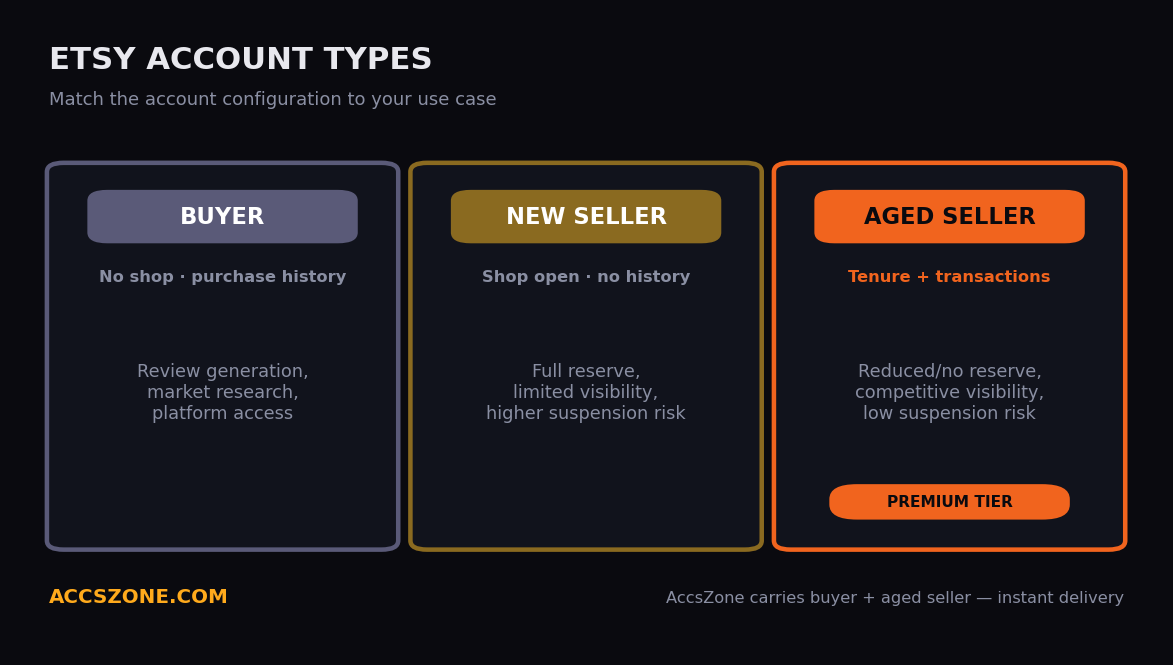
An Etsy buyer account is a registered account with purchase history but no shop opened, used for review generation, market research, and platform access.
Account transfer is the gradual process of updating a purchased account's email, password, and payment details, plus its IP/device, without triggering Etsy's account-review system.
Why Sellers Buy Aged Etsy Accounts
The decision to buy an aged Etsy account rather than register a new one comes down to a specific set of operational problems every new Etsy seller encounters.
Payment reserves and cash flow. Etsy's payment reserve is the most immediately impactful friction point. When a new account is placed on reserve, Etsy holds a portion of proceeds — sometimes 75% or more — until the account meets a transaction-volume and time threshold. For sellers needing immediate cash flow, a 45–90 day reserve is a serious constraint. Aged accounts that have cleared the reserve threshold don't face the same holds — effectively buying past the cash-flow bottleneck that traps new sellers.
Search ranking and listing visibility. Etsy's search algorithm factors account age and transaction history into visibility. A new account's listings compete at a disadvantage against established shops with reviews and sales history. An aged account brings baseline credibility to listings from day one, without weeks or months of grinding for first reviews.
Shop suspension risk during initial review. Etsy performs automated reviews of new accounts during the first 30–90 days. Accounts that trigger policy flags — even minor ones — face suspension at higher rates than established accounts. An aged account that has already survived Etsy's initial review gauntlet is structurally less vulnerable to early-stage flags.
Multiple shop management. Professional sellers — print-on-demand operators, digital-product sellers, handmade-goods agencies — often run multiple shops across niches or client brands, each requiring a separate account. Purchasing aged accounts for each shop provides better starting conditions for each market entry.
Relisting after suspension. Sellers who've had a shop suspended can't simply register a new account and reopen — Etsy links new accounts to device fingerprints, IPs, and email/payment patterns. Starting fresh with a purchased aged account (using proper IP and device isolation) provides a clean slate not linked to the suspended account's identity.
Etsy Account Types: Buyer vs. Seller vs. Aged Seller
Not all Etsy accounts serve the same purpose. Understanding the three main configurations prevents a mismatch between what you buy and what your operation needs.

Etsy Buyer Account. A registered account with no shop opened — used purely for purchasing. Buyer accounts accumulate purchase history, reviews given to sellers, and a tenure date Etsy's system recognizes. Use cases: review generation (a buyer account with purchase history can leave verified reviews on your seller shop, building social proof early), market research (monitoring competitor shops and pricing from multiple perspectives), and platform access (favorite/watchlist tools useful for market analysis).
Etsy Seller Account (New Shop). A seller account with a shop opened but minimal or no transaction history — the standard starting point for new sellers. The limitations above (payment reserve, limited visibility, higher suspension risk) apply in full.
Aged Etsy Seller Account. A seller account created months or years ago, with transaction history, potentially positive reviews, and in good standing. The premium tier for buyers needing immediate operational capability. Value is defined by: account creation date (tenure credit), transaction history (demonstrated legitimate selling), review record (a credibility floor new shops spend months building), payment-reserve status (whether it has cleared the threshold), policy-violation record (zero violations = clean start), and shop-category history (established activity in your target category provides more relevant baseline trust).
AccsZone offers both Etsy seller accounts and Etsy buyer accounts — letting buyers acquire the exact configuration they need.
How Account Age Affects Etsy's Trust Score and Payment Holds
Etsy doesn't publish its internal trust-scoring methodology, but years of seller-community observation have identified the key levers.

| Account Age | Typical Reserve Status | Search Visibility | Suspension Risk |
|---|---|---|---|
| 0–30 days | Full reserve (75%+) | Minimal — lowest tier | High — automated review active |
| 31–90 days | Partial reserve | Low — building | Moderate |
| 91–180 days | Reserve reducing | Moderate | Lower |
| 6–12 months | Reserve likely cleared | Good | Low |
| 12+ months with sales | No reserve | Full competitive visibility | Minimal |
Payment reserve mechanics. Etsy's reserve is applied per shop and tied to the shop's sales history, not account age alone. But account age is a qualifying factor — shops new in both age and volume face the longest reserves. Aged accounts with transaction history are much more likely to have cleared the threshold or to clear it quickly with first sales.
Review count and trust score. Every completed sale that generates a 5-star review adds to the shop's trust score. Accounts with existing positive reviews start at a higher floor — even 5–10 reviews create a meaningful difference in how Etsy treats the shop in search and during policy reviews.
Listing approval speed. New shops' listings go through a more rigorous initial review queue. Established accounts' listings are typically approved faster because account history reduces the system's uncertainty about legitimacy.
What this means practically. An aged account with 12+ months of tenure and some transaction history can potentially start selling with no payment reserve, competitive search visibility from the first listing, and low automated suspension risk. The gap between that starting position and a brand-new account is significant — the core reason buyers invest in aged accounts. (The same trust-by-age principle drives the market for aged Facebook accounts and most other platforms.)
AccsZone Etsy Account Catalogue
AccsZone operates as a direct-production marketplace — all accounts are produced and maintained in-house. For Etsy, this means every account specification (creation date, transaction history, policy record) is controlled at the production level, with no third-party sellers and no risk of misrepresented history, instant automated delivery on all orders, published pricing with no negotiation, and 24/7 live human support for setup and transfer questions.
Etsy Buyer Accounts: registered accounts with purchase history, available in various tenure ranges, suitable for review generation, market research, and platform access — instant automated delivery.
Etsy Seller Accounts (Aged): seller accounts with a shop opened and account tenure, in various age ranges, may include transaction history depending on tier — suitable for launching new shops with reduced reserve risk, multi-shop operations, and relisting after suspension, with instant automated delivery.
Bulk ordering: 5% discount at 500+ accounts, 10% at 2,000+; deposit bonuses of 3% under $500, 5% at $1,000+, 7% at $2,000+. For agencies managing multiple client shops or print-on-demand operations needing multiple shop accounts, bulk ordering with instant delivery and live coordination is available.
The catalogue gap on competing platforms. FameSwap, SocialTradia, Flippa, and G2G do not carry Etsy accounts as a product category. Sellers are occasionally listed on Flippa as full business acquisitions, but individual account purchases for operational use are absent from every P2P platform's catalogue. AccsZone operates in this category essentially alone among structured marketplaces — see the full breakdown in our AccsZone vs competitors comparison.
How to Transfer an Etsy Seller Account Safely
Purchasing an aged Etsy account is the first step. Transferring it to your control and beginning operations without triggering Etsy's review system is what determines whether the account's age advantages actually materialize.

Step 1: Change the email address first. The email is the primary account identifier on Etsy. Before changing anything else, update it to one you control — an aged, active Gmail or similar, not a freshly created throwaway. (AccsZone's Gmail catalogue covers buyers who need a clean email for this.) Allow 24–48 hours after the email change before further modifications; rapid sequential credential changes are a flag pattern.
Step 2: Update the password. After the email change settles (24–48 hours), set a strong, unique password not used on any other platform.
Step 3: Update payment information. Etsy requires a payment method for seller fees. Add your card or bank account after email and password changes have settled — 48–72 hours after acquisition is reasonable.
Step 4: Review and update shop details. Check the existing shop name, banner, description, and policies. Decide whether to keep the existing identity (if it has relevant history) or rebrand. Make changes gradually — updating everything at once looks like a wholesale takeover to Etsy's system. Space changes across several days.
Step 5: Use consistent IP and device. Access the account from a consistent IP and device from first login. Establish your intended environment (computer or proxy setup) for the first login and maintain it. Dramatic login-location changes early in ownership commonly trigger identity-review prompts.
Step 6: Begin listing gradually. Don't list 50 products on day one. Start with 3–5 listings, let them go live and receive some traffic, then add more. This gradual onboarding aligns with how legitimate new owners behave.
Step 7: Maintain the existing communication style (if applicable). If the account has existing buyer messages or open conversations, review them before responding. Replying in a completely different style or timezone from previous activity can flag as a new operator.
AccsZone's Help Center and live support can walk through any step of this transfer in real time — a meaningful advantage over informal suppliers with no post-sale support.
Comparison: AccsZone vs. Other Etsy Account Sources
| Source | Seller | Aged | Buyer | Instant Delivery | Live Support | Price Clarity |
|---|---|---|---|---|---|---|
| AccsZone | ✓ | ✓ | ✓ | ✓ automated | 24/7 live (minutes) | Published |
| Flippa | ✓ (full business) | Sometimes | ✗ | ✗ auction | Ticket (24–72h) | Negotiated |
| Fiverr / Freelancer | ✓ | Sometimes | Sometimes | ✗ delay | Seller-dependent | Seller-set |
| Telegram vendors | ✓ | Rarely | Sometimes | Sometimes | Chat (variable) | Informal |
| FameSwap / SocialTradia | ✗ | ✗ | ✗ | ✗ | Ticket (24–72h) | N/A |
| G2G | Rare | Rare | ✗ | Partial | Ticket (24–72h) | Seller-set |
What makes Flippa different for Etsy. Flippa does occasionally list Etsy shops as full business acquisitions — with revenue data, traffic reports, and broker-assisted due diligence. That's appropriate for a significant acquisition (a shop generating $5,000+/month, say) where the business-acquisition framework fits. It's not the right path for buyers who need individual accounts for operational use, multi-shop management, or agency purposes. Flippa's success fees and auction timelines also make it impractical for account-level purchasing.
The structured-marketplace gap. For individual Etsy account purchases — buyer accounts, aged seller accounts, or operational pools — AccsZone is the only structured marketplace with in-house inventory, published pricing, instant delivery, and live support. The alternatives are informal sellers with no standardized quality or support infrastructure.
Platform Policy, Risk, and Compliance — What Buyers Should Know
This section exists because any honest guide to this market has to state the rules clearly.
Etsy's Terms of Use prohibit the sale or transfer of accounts. Purchasing one does not change that. The practical consequence of a detected transfer is platform enforcement — account suspension — not legal liability in most jurisdictions for ordinary commercial selling. Sellers in this market treat account risk as a known, priced-in cost, the same way they treat Etsy fee changes or algorithm shifts.
Three things follow that every buyer should internalize:
- No account is suspension-proof. Tenure, transaction history, and a careful transfer lower the risk; they don't eliminate it. Any supplier claiming a guarantee against suspension is misrepresenting the product.
- Risk allocation is standard. AccsZone covers failures before first login; everything after — transfer mistakes, listing-policy violations, payment issues — is operational risk that sits with the buyer.
- Selling law applies independently of the account. Your listings must comply with Etsy's handmade/vintage/craft-supply policies and with consumer-protection, tax, and intellectual-property law in the markets you sell to, regardless of which account lists them.
AccsZone publishes this openly because informed buyers make better operational decisions — and the buyers who succeed are the ones who manage risk deliberately rather than assuming it away.
FAQ: Etsy Account Questions
Why do sellers buy aged Etsy accounts instead of starting fresh?
The two primary reasons are payment reserves and search visibility. New accounts face holds of 75%+ of proceeds for 45–90 days, and limited search visibility until transaction history accumulates. Aged accounts with existing history can bypass or shorten both, compressing the timeline from creation to fully operational selling.
What is an Etsy payment reserve and how does account age affect it?
Etsy holds a portion of new sellers' proceeds as a payment reserve until the account demonstrates sufficient legitimate selling history. The percentage and duration depend on account age, transaction volume, and review count. Accounts older than 12 months with sales history are much more likely to have cleared the threshold — meaning proceeds are released quickly rather than held.
Can I change the shop name and branding on a purchased Etsy seller account?
Yes. Etsy allows shop names to be changed (with some frequency limits). After acquiring an account you can update the name, banner, description, and policies to match your brand. Make these changes gradually over several days rather than all at once, to avoid triggering Etsy's account-review system.
How do I transfer a purchased Etsy account without getting flagged?
Update credentials in sequence with 24–48 hour gaps: email first, then password, then payment information. Access the account from a consistent IP and device from first login. Make shop changes gradually rather than all at once. AccsZone's live support can walk through each step in real time.
What are Etsy buyer accounts used for?
Primarily review generation (purchasing from your own shop to build early review count), market research (monitoring competitor listings from multiple perspectives), and platform access (favorite and watchlist features for tracking). They are registered accounts with purchase history but no seller shop opened.
Is buying an Etsy account against Etsy's terms of service?
Etsy's terms state accounts should not be transferred or sold — standard language across most e-commerce platforms. The practical risk is account suspension if Etsy detects the transfer, mitigated by following the transfer protocol (gradual credential changes, consistent IP, normal behavioral patterns). AccsZone's pre-login protection covers accounts that have issues on arrival before the buyer begins the transfer.
Does AccsZone offer Etsy accounts in bulk?
Yes. AccsZone delivers Etsy account orders with instant automated delivery. Bulk discounts apply at 500+ accounts (5%) and 2,000+ accounts (10%). Deposit bonuses provide additional value: 3% on deposits under $500, 5% at $1,000+, 7% at $2,000+.
Why aren't Etsy accounts available on FameSwap or SocialTradia?
FameSwap and SocialTradia are P2P platforms focused on social media channel acquisitions; their seller communities don't offer Etsy accounts because the e-commerce account use case doesn't fit their focus or audience. AccsZone's in-house model covers categories outside P2P scope — Etsy, Craigslist PVA, Gmail, WhatsApp LD backup, and AI platform accounts all have no meaningful P2P presence.
Get Aged Etsy Seller and Buyer Accounts — Instant Delivery, Live Support
AccsZone is the only structured marketplace offering Etsy seller and buyer accounts with in-house production, instant automated delivery, published pricing, and 24/7 live human support.
No waiting for individual sellers. No ambiguity about account age or transaction history. No support ticket queue when transfer questions come up.
Reduced payment holds · higher trust score · instant delivery · 24/7 live support · Telegram @accszone1
Browse Etsy Accounts →
Related guides: Aged Facebook Accounts · Craigslist PVA Accounts · AccsZone vs Competitors