How to Choose Proxies for Managing Multiple Accounts in 2026
Managing multiple accounts is common in e-commerce, social media marketing, advertising, affiliate marketing, and other digital fields. However, separating accounts into different browser profiles is not always enough - the network environment also plays an important role.
Websites may take into account an IP address, its geolocation and provider, browser parameters, cookies, and other connection characteristics. If multiple accounts regularly use the same IP address or their connection locations constantly change, it may become easier for platforms to associate this activity.
That's why proxies for account management shouldn't be chosen based only on price or the number of available IPs. Proxy type, connection stability, location, and rotation settings also matter.
Which Proxies Are Suitable for Account Management?
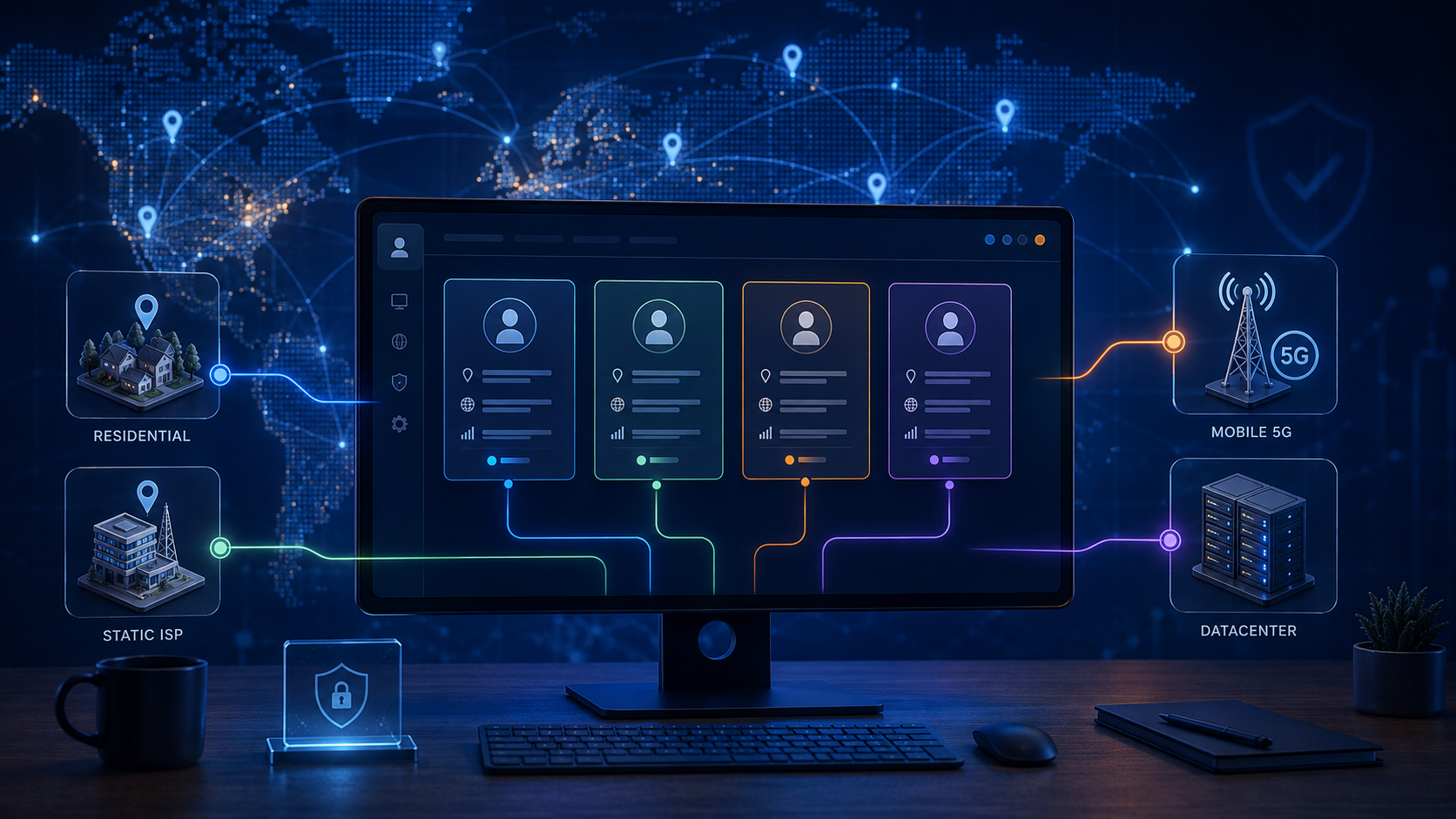
The main options are Residential, ISP, Mobile, and Datacenter proxies. Each type has its own characteristics and is better suited to particular tasks.
Residential Proxies
Residential proxies use IP addresses associated with Internet service providers and provide access to large pools of addresses across different countries and regions.
They are suitable for tasks where broad geographic coverage and IP rotation are important, including market research, localized content access, e-commerce, data collection, and other scenarios.
For long-term account sessions, however, rotation should be configured carefully. If the IP changes too frequently, the network environment becomes less consistent. In these cases, sticky sessions can be used to keep the same IP address for a specified period.
Static ISP Proxies
If an account requires a consistent IP address, Static ISP proxies are one of the most convenient options.
A dedicated IP can be assigned to a specific browser profile and used for regular sessions. This approach is suitable for social media, advertising accounts, e-commerce, and other accounts that are managed over long periods.
For example:
Account A → Profile A → ISP Proxy A
Account B → Profile B → ISP Proxy B
Account C → Profile C → ISP Proxy C
This structure makes the setup easier to manage and scale as the number of accounts grows.
Mobile Proxies
Mobile proxies route traffic through mobile carrier networks such as 3G, 4G/LTE, and 5G.
They are particularly relevant for mobile-first platforms, mobile applications, social media workflows, and tasks where a connection through a mobile carrier is required.
However, Mobile proxies are typically more expensive than other proxy types, so they aren't necessary for every scenario.
Datacenter Proxies
Datacenter proxies operate through server infrastructure. Their main advantages are high speed, affordability, and scalability.
They are well suited for automation, monitoring, SEO tools, and data collection. For long-term account management, however, ISP, Residential, or Mobile IPs are often preferred depending on the requirements of a particular platform.
Static or Rotating IP?
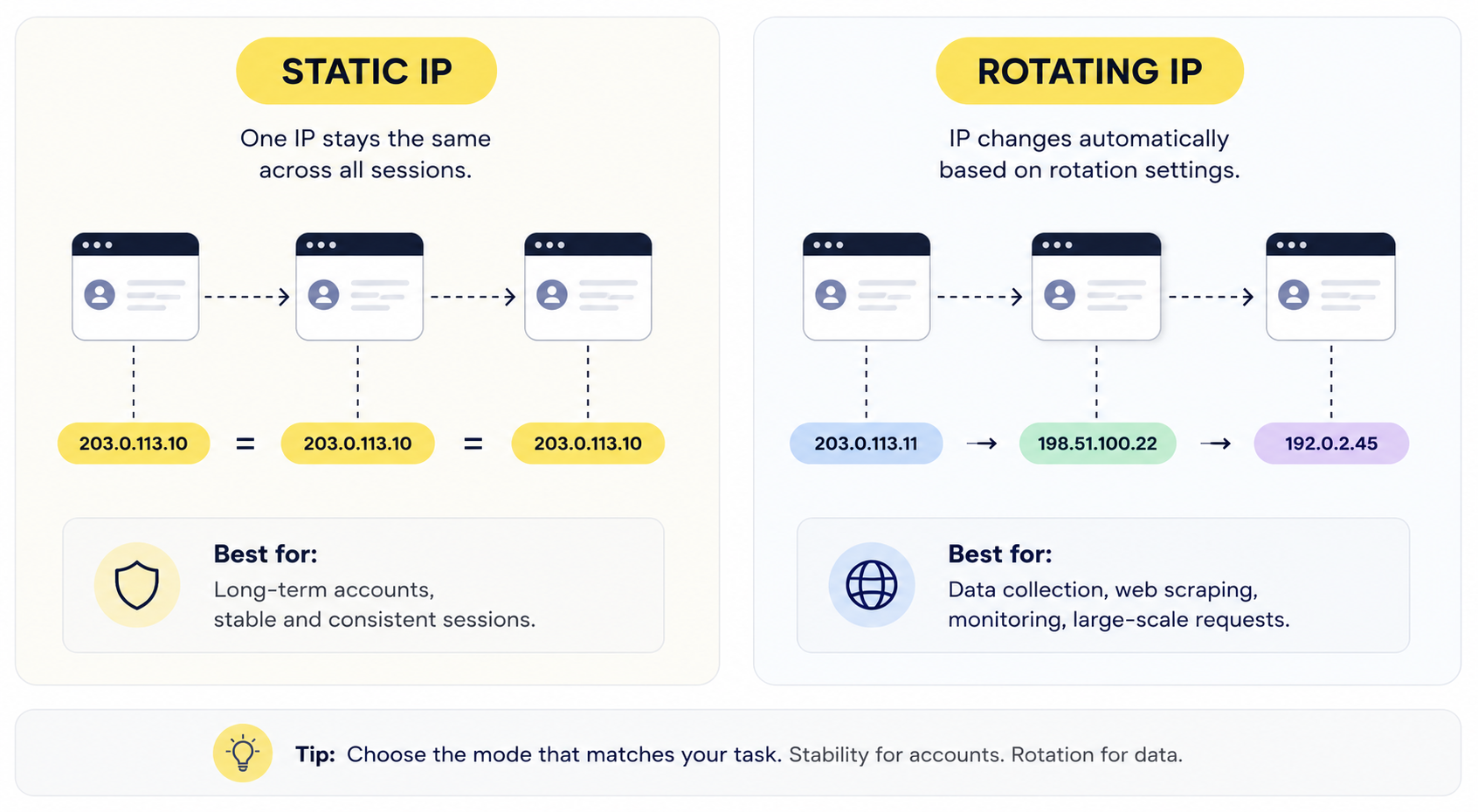
The right choice depends on the task.
A static IP is convenient for accounts that are accessed regularly. If a profile consistently operates from the same country and IP address, its network environment remains more consistent.
IP rotation is more useful for tasks that require a large number of requests from different addresses, such as web scraping, monitoring, or search result collection.
For a single long-term account, frequent IP changes are usually unnecessary.
If an account connects from Germany, then from the United States a few minutes later, and then from France, this creates a less consistent connection history than using one suitable IP.
Keep GEO Settings Consistent
It's important to consider not only the IP address itself but also how its location matches the rest of the profile settings.
Where possible, align:
-
proxy country;
-
account region;
-
timezone;
-
browser language;
-
locale.
For example, if an account is intended for the German market, it makes sense to use a German IP together with corresponding browser profile settings.
For many tasks, country-level targeting is sufficient. If more precise localization is required, choose proxies that support state or city-level targeting.
Don't Use the Same Configuration for Every Task
A common mistake is trying to use the same proxy setup for account management, scraping, and automation.
These tasks have different requirements.
For persistent accounts, the priority may be a stable IP. For data collection, a large proxy pool and rotation are more important. For mobile-first platforms, a mobile network may be the better choice.
A simple infrastructure setup could look like this:
Long-term account management → Static ISP
Scraping and large-scale data collection → Residential / Dynamic ISP / Datacenter
Mobile-specific tasks → Mobile proxies
This makes it easier to manage traffic, rotation, and the network environment for each workflow.
What to Look for in a Proxy Provider
When choosing a proxy provider, price per GB or per IP shouldn't be the only consideration.
Pay attention to:
-
available countries and regions;
-
rotation controls;
-
sticky session duration;
-
HTTP/HTTPS/SOCKS5 support;
-
connection speed and stability;
-
availability of different proxy types.
If one provider offers several proxy categories, you can choose separate infrastructure for account management, data collection, and automation instead of using the same solution for every task.
MangoProxy for Account Management
MangoProxy offers Residential, ISP, Datacenter, and dedicated Mobile proxies with coverage in more than 200 countries.
For long-term browser profiles, Static ISP proxies can be used to maintain a consistent IP address for an account.
For tasks that require rotation and access to a larger IP pool, Residential and Dynamic ISP proxies are available. Dedicated 4G/5G proxies can be used for mobile-specific workflows.
This allows users to choose the type of connection based on the specific task rather than relying on a single proxy configuration for every workflow.
Special Offer for AccsZone Users
AccsZone users can get 8% off MangoProxy Static ISP proxies with promo code ACCSZONE.
Final Thoughts
When managing multiple accounts, the browser profile isn't the only factor to consider. The network environment matters as well.
For persistent accounts, IP stability is often more important than frequent rotation. For scraping and large-scale requests, the opposite may be true - access to a large IP pool and rotation can be more useful.
The key is to choose proxies according to the task, keep GEO settings consistent, and avoid using the same configuration for account management, scraping, and other types of workloads.
This makes the infrastructure easier to manage and scale as the number of accounts grows.