Scaling with Multiple Ad Accounts Without Creating Payment Chaos
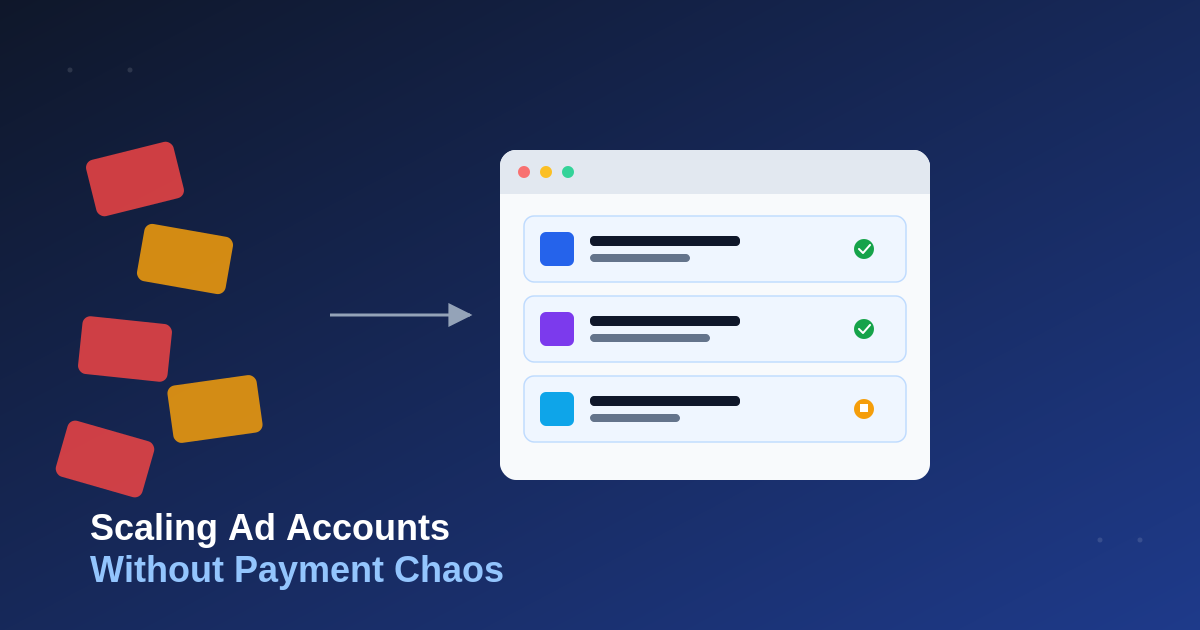
Running multiple ad accounts helps you scale campaigns, test new markets, and separate budgets across clients or projects. However, as the number of accounts grows, payment management often becomes a primary operational challenge. A single declined card can pause high-performing campaigns, disrupt algorithmic optimization, and create extra manual accounting work for your team.
Building a clear, organized payment framework helps keep your ad accounts active and your financial records organized.
Choosing Your Payment Architecture
Managing payment methods across multiple ad accounts requires a clear organizational structure. Media buying teams and agencies typically adopt one of three primary models depending on their scale and operational setup:
| Setup Model | Best For | Operational Benefit |
|---|---|---|
| One Card per Ad Account | High-spend campaigns and rapid testing | Separates payment issues effectively; a decline on one account is less likely to affect others. |
| One Card per Client | Digital marketing agencies | Simplifies invoice reconciliation and client budget tracking. |
| One Card per Platform | Multi-channel advertisers | Streamlines cross-platform reporting and platform-specific billing organization. |
Practical Example: Agency Execution
An agency managing 30 Meta ad accounts across five e-commerce clients can standardize its setup by issuing dedicated virtual cards per client and assigning internal accounting identifiers such as ClientA_Meta_Scale.
By actively monitoring the balance on each card, the team can reduce unintended overspending, streamline weekly reconciliation, and help ensure that a payment issue affecting one client does not interrupt campaigns for another.
Platform-Specific Billing Nuances
Advertising platforms enforce distinct billing rules and security checks. Understanding these technical nuances can help prevent unexpected account interruptions:
Meta Ads: Meta uses billing thresholds that can vary by account. If a card charge fails when a billing threshold is reached, Meta may temporarily pause ads and place the account on payment hold. Repeated payment failures may trigger additional payment verification or temporary billing restrictions.
Google Ads: Google Ads offers Automatic Payments, Manual Payments, and Monthly Invoicing, although availability depends on factors such as the billing country, currency, and account eligibility. Frequent changes to billing details or payment methods may, in some cases, trigger additional payment verification.
TikTok Ads: Available payment methods vary according to the account's billing country or region, billing option, and currency. Teams should confirm that a payment method is supported for the specific account setup before assigning it.
Streamlining Operations with Virtual Cards
Managing physical bank cards or sharing a single corporate card is often inefficient for growing operations. Specialized virtual card solutions can give media buying teams a clearer way to separate budgets and manage payment instruments.
Pay2.House is one example built for advertising and other online payments. The platform supports Standard virtual cards for services including Meta Ads, Google Ads, and TikTok Ads, as well as bulk card issuance and a choice of available BINs and GEOs. From the Cards & Accounts dashboard, users can view balances, manage active cards, and review transaction histories and operation statuses.
For example, when an agency launches campaigns for a new client, it can issue separate Pay2.House Standard cards for the client's ad accounts, fund each card according to its planned budget, and monitor balances and transaction attempts from one dashboard.
If the agency needs to launch multiple accounts at once, bulk issuance can reduce repetitive setup work. This creates a practical link between account separation, day-to-day payment monitoring, and reconciliation as the operation grows.
Typical virtual card workflows include:
- Dedicated card issuance: Create separate virtual cards for ad accounts, campaigns, clients, or projects.
- Payment separation: Keep client and platform spending on distinct payment instruments.
- Centralized monitoring: Review balances, card statuses, and transaction activity from one interface.
- Scalable setup: Issue multiple cards when a team needs to prepare several account payment setups at once.
The Standardized Scaling Workflow
To scale ad spend efficiently with less operational friction, consider this five-step payment workflow:
- Standardize card naming: Label every card immediately upon creation using a clear format, such as Platform_Buyer_Client_ID.
- Monitor card balances: Plan campaign budgets in advance and maintain sufficient funds for anticipated billing cycles.
- Prepare a backup payment method: For critical ad accounts, keep a verified alternative payment method ready where the platform and account setup allow it. If the primary card stops working, the team can restore payments more quickly. Adding a backup card is not enough — it should be checked regularly for:
- its expiration date;
- available balance;
- applicable spending limits;
- accurate and up-to-date billing details.
- Monitor spending regularly: The more ad accounts a team manages, the more frequently it should review spending. Operational checks can be performed daily or weekly to identify payment failures, unusual activity, and potential budget overruns early.
- Conduct monthly financial reconciliation: Perform a complete reconciliation at least once a month. Match transaction records with internal project IDs and review budget overruns, unfamiliar transactions, and payment methods that are no longer being used.
FAQ
Should every ad account have a unique payment method?
For teams that manage multiple campaigns or client accounts, separating payment methods can help contain billing issues and simplify reconciliation. For agencies, allocating one dedicated payment method per client often provides a practical balance between operational control and bookkeeping.
Why do banks decline recurring ad payments?
Declines can occur because of transaction velocity flags, security checks related to international billing parameters, insufficient funds, or standard bank limits. Using dedicated virtual cards, maintaining sufficient balances, and keeping billing details up to date can help reduce avoidable payment failures.
Can multiple Google Ads accounts share one billing profile?
Multiple Google Ads accounts may be able to use the same Payments profile through a Manager Account. Availability depends on the payment setting, account configuration, user permissions, and eligibility for features such as monthly invoicing or consolidated billing.
Conclusion
Scaling advertising operations requires attention to financial workflows alongside creative strategy and media buying. By separating payment methods, using virtual cards appropriately, and maintaining regular oversight of advertising expenses, teams can reduce payment friction.
An organized payment approach helps keep advertising operations stable and easier to manage as spending grows.
Manage Your Ad Payments →