Where to Buy Old Facebook Accounts in 2026: 7 Best Sources
Facebook keeps tightening verification on new accounts. Fresh profiles run into ad spend caps, Marketplace lockouts, and Business Manager restrictions that take weeks to clear. Aged accounts skip those waiting periods because they already carry the trust signals Meta's algorithms reward.
That has created a real market for sourcing aged Facebook profiles, with platforms ranging from professional in-house producers to open multi-vendor marketplaces and informal brokers. Quality varies dramatically across them. So does what happens when something arrives broken.
This guide ranks the seven best sources to buy aged Facebook accounts this year, what each one is good for, and the risks to know before paying.
What "aged" actually means on Facebook
An aged Facebook account is a profile created at least several months ago, ideally a year or more, with a consistent login history and some baseline activity. The age itself isn't what matters. What matters is the accumulated trust signals: consistent logins from a stable region, organic-looking friend additions, occasional posts or reactions, and a clean record with no recent restrictions.
Accounts created in 2007 through 2015 sit at the top of the market because they carry over a decade of behavioral history. Accounts created in 2020 to 2023 still pass most trust checks and cost a fraction of premium aged inventory. Anything created in the last six months is functionally a fresh account, regardless of what the seller claims.
How sellers source their inventory
There are three production models in the aged Facebook account market.
In-house production. The platform registers, warms, and verifies accounts on its own infrastructure using country-specific IPs, real phone numbers, and mobile proxies. Quality is consistent because every account goes through the same controlled process. Replacement and support are handled directly by the platform.
Third-party marketplace. Individual sellers list their inventory on a platform that takes a cut and provides escrow. Selection is wide and pricing flexible, but account quality varies because each seller follows their own production methods. Disputes can be slow.
Informal brokers. Private sellers operating through Telegram groups, forums, or chat apps. Often the cheapest option, almost always the riskiest. No platform, no escrow, no recourse if the account fails or gets reclaimed.
Understanding the production model behind a marketplace matters more than the marketing copy on the homepage. The rest of this guide evaluates seven platforms on that basis.
7 Best Sources to Buy Aged Facebook Accounts in 2026
1. AccsZone
AccsZone operates as an in-house production specialist rather than a reseller marketplace. Every Facebook, Instagram, Gmail, and LinkedIn profile sold on the platform is registered using country-specific IPs, real phone numbers, and mobile proxy infrastructure managed in-house. Each account passes verification checks for activity patterns and device consistency before being added to inventory.
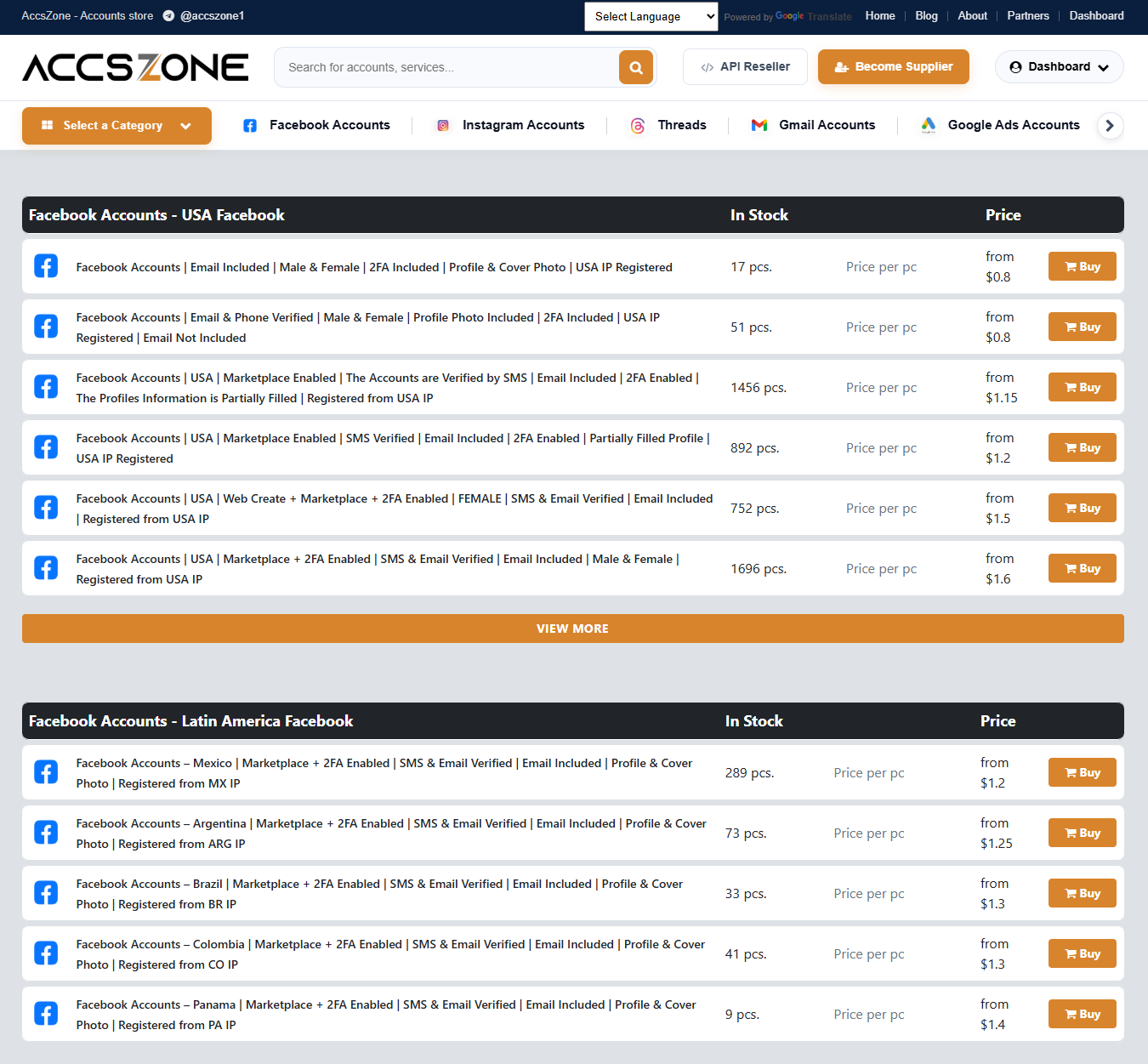
The Facebook catalog is structured around buyer use cases. PVA accounts for Marketplace posting start at $0.80 per piece. Marketplace-enabled accounts with 2FA and SMS verification start at $1.15. Business Manager-activated profiles ready for direct ad spending begin at $0.75. Follower-tier accounts come in 100, 1000, and 5000+ tiers. At the premium end, aged USA Facebook accounts from 2007 to 2015 with 1000 to 2000 real friends and original Gmail access start at $700 per piece.
Geographic coverage runs across USA, UK and Europe, Latin America, North America and Oceania, Asia Pacific, and the Middle East and Africa, each with country-specific IPs. Delivery is automated and instant after payment. Checkout supports crypto through Cryptomus alongside card. Replacements are handled directly by 24/7 human support without third-party dispute layers. An API reseller program and a 50% supplier marketplace sit on top of the consumer storefront.
Key Features
- In-house production with country-specific IPs, real phone numbers, and managed mobile proxy infrastructure
- 14 Facebook sub-categories: PVA, Marketplace-enabled, Business Manager, aged 2007 to 2026, follower-tier, with friends, dating, premium
- Original email access included on aged tiers
- Automated instant delivery, crypto and card checkout
- 24/7 human replacement support, no third-party dispute system
- API reseller program for resale buyers
- 40+ product categories beyond Facebook (Instagram, Gmail, LinkedIn, TikTok, dating, finance, services)
|
Pros
|
Cons
|
Average Facebook Account Age: 6 months to 19 years (2007 to 2026 inventory available)
Who should buy here: Agencies, media buyers, dropshippers, and SMM operators who need consistent quality across a wide category mix from a single reliable supplier.
2. AccsMarket
AccsMarket is the largest open marketplace for social media accounts by inventory volume. It operates as a multi-vendor platform where individual sellers list their inventory and AccsMarket provides the storefront, payment processing, and basic dispute handling. Facebook accounts span four tiers: auto-registered, aged, promoted or grown, and Real User Profiles previously used by genuine users.
Buyers come to AccsMarket for the inventory depth. If a buyer needs 200 of a specific account type today, the catalog usually has it when no one else does. The trade-off comes from the multi-vendor model. Quality varies across suppliers, the replacement window is short, and the platform doesn't control individual seller production standards.
Key Features
- Multi-vendor marketplace with extensive inventory
- Four-tier classification: auto-reg, aged, promoted, Real User Profiles
- Card and crypto checkout
- No registration required for purchase
- Regional filtering across most major countries
|
Pros
|
Cons
|
Average Facebook Account Age: 6 months to 5 years
Who should buy here: Experienced operators who already have an inbound account verification process and need maximum volume.
3. Uproas
Uproas positions itself as a structured infrastructure provider rather than a casual reseller. The platform focuses on compliance-oriented account sourcing with internal verification processes and documentation aimed at agencies and business buyers. Pricing trends premium, and the catalog is narrower than open marketplaces.
What Uproas does well is positioning. The platform pitches itself toward agencies running advertising, lead generation, or brand management workflows that need consistent account quality and structured replacement procedures. For buyers with budget priorities focused on documentation and onboarding support over raw inventory volume, the offering fits well.
Key Features
- Verified aged Facebook accounts with documented history
- Pre-screening for activity and device consistency
- Onboarding documentation and proxy guidance
- Structured replacement procedures
- Business and ad infrastructure integration
|
Pros
|
Cons
|
Average Facebook Account Age: 12 months to 10+ years
Who should buy here: Agencies and businesses prioritizing documentation and compliance frameworks over inventory breadth.
4. PlayerUp
PlayerUp is one of the longest-running digital marketplaces online, originally built for gaming accounts and later expanded to include social media profiles. Facebook accounts are sold through individual vendors using an escrow-backed transaction system with dispute mediation.
The platform works as a trading hub rather than a quality-controlled provider. Buyer protection is solid because of the escrow layer and community moderation, but account quality depends entirely on which vendor a buyer chooses. Due diligence on seller history and account specifications is critical before payment.
Key Features
- Escrow-based transaction system
- Vendor reputation and rating mechanisms
- Dispute resolution process
- Long operational track record
- Active community moderation
|
Pros
|
Cons
|
Average Facebook Account Age: 6 months to 5 years
Who should buy here: Buyers who prioritize escrow protection and are comfortable vetting individual sellers themselves.
5. SWAPD
SWAPD runs a vetted-member forum marketplace rather than an open storefront. Membership requires application and screening, which keeps the buyer and seller pool noticeably cleaner than open competition. Listings skew toward higher-value assets including established YouTube channels, monetized Facebook Groups, and large Instagram accounts in commercial niches.
For premium single-asset acquisitions, SWAPD is one of the more reliable options online. For bulk volume orders or specific commodity-level account types, the marketplace structure doesn't fit well. Internal search and filtering struggle when buyers need something very specific, and approval timelines can slow down urgent purchases.
Key Features
- Vetted-member forum structure
- Higher-value asset focus (YouTube channels, Facebook Groups, Instagram)
- Native escrow on transactions
- Strong reputation system
- Long deal-history public record
|
Pros
|
Cons
|
Average Facebook Account Age: 1 to 8 years (varies by listing)
Who should buy here: Buyers acquiring premium single-asset accounts (large Groups, monetized Channels) who prioritize trust over speed.
6. FameSeller
FameSeller is a semi-curated reseller targeting influencers, small agencies, and marketers looking for pre-aged profiles bundled with supporting materials like cookies or recovery information. The platform maintains more control over sourcing than open marketplaces but operates at a smaller scale than full-service infrastructure providers.
Account onboarding tends to be straightforward and support is responsive. The trade-off is inventory scale. For buyers placing single-digit orders with basic compliance needs, FameSeller works well. For agencies running 50+ unit orders weekly, the inventory depth doesn't match what specialists offer.
Key Features
- Curated account inventory
- Login materials and cookies bundled
- Activity-verified profiles
- Basic warranty coverage
- Regional account filtering
|
Pros
|
Cons
|
Average Facebook Account Age: 8 months to 3 years
Who should buy here: Solo marketers and small agencies with low-volume needs and basic compliance requirements.
7. AccsBulk
AccsBulk specializes in bulk-volume orders for buyers who need fifty or more accounts of the same type from a single supplier. The catalog overlaps with the broader specialist market but is structured around volume pricing and consistent batch quality rather than a la carte selection. Checkout supports crypto, delivery is automated, and the platform runs an open supplier marketplace for resellers offloading inventory at scale.
Key Features
- Bulk-order optimized pricing structure
- Batch-consistent quality across volume orders
- Crypto checkout and automated delivery
- Open supplier marketplace for resellers
|
Pros
|
Cons
|
Average Facebook Account Age: 3 months to 4 years
Who should buy here: Agencies and resellers placing recurring 50+ unit orders against a single supplier.
Why agencies prefer aged accounts over fresh ones
Aged Facebook accounts carry behavioral history, device consistency, and engagement patterns that new profiles cannot replicate. Those signals reduce automatic flags triggered by sudden activity, ad campaign launches, or monetization attempts. Facebook's algorithms treat aged profiles as established users rather than potential bots.
Established accounts gain Marketplace access, Business Manager features, ad spending limits, and messaging capabilities faster than fresh registrations. They also tend to have higher posting limits and more reliable long-term login stability. For agencies and media buyers managing client campaigns under deadline pressure, that translates into faster deployment, fewer verification roadblocks, and reduced early-stage account loss.
Warming a fresh account from scratch to passable trust takes three to six weeks of careful, controlled activity. Agencies running multi-client workflows rarely have that runway available. Buying pre-warmed accounts skips the warm-up window entirely.
The risks and how to manage them
Facebook's terms of service prohibit the unauthorized sale and transfer of personal accounts. Enforcement is automated and inconsistent. Some accounts run for years without issue, others get restricted within hours of transfer. The risk profile depends entirely on three factors: account quality at the source, how the new owner handles the first 48 hours, and ongoing operational hygiene.
The highest-risk purchases come from informal brokers operating through Telegram or chat apps with no platform, no escrow, and no replacement guarantee. These sellers frequently move stolen accounts, accounts linked to compromised devices, or accounts reclaimable by the original owner. When something fails, there's no recourse.
The lowest-risk approach uses platforms with in-house production, documented account history, original email access included in the sale, and a clear replacement window. Even then, no account is fully immune to Facebook enforcement. Sustainable operations combine quality sources with disciplined post-purchase handling.
How to evaluate an account before you buy
- Registration date. Confirm the claimed account age matches what's visible in the profile. Anything under three months old isn't really aged.
- Email access. The original email needs to come with the sale and be fully transferable. Without email control, the seller can recover the account later.
- Country of registration vs. your login geo. Mismatched IPs trigger checkpoints. An account registered on a US IP needs a US residential or mobile proxy to log in cleanly.
- 2FA control. The 2FA key has to be transferred, not a phone number the seller still controls. SMS access in the seller's hands means recovery access in the seller's hands.
- Activity history. Aged plus warmed beats aged alone. An empty profile with no posts, friends, or reactions triggers reviews faster.
- Replacement window. Confirm the policy before paying. Industry standard runs 24 to 72 hours. Test the account the day it arrives.
- Payment method. Pay through platform checkout or platform-held escrow. Never wire money to a Telegram contact regardless of how good their screenshots look.
The first 48 hours after purchase
Most preventable bans happen in the first two days after a buyer takes control. Change the password and recovery email immediately, then enable 2FA on a personal authenticator app. After that, leave the account alone. Updating the password, swapping the recovery email, switching the phone number, and launching an ad campaign within the first hour looks to Meta's anomaly detection like a hack in progress.
Log in through an anti-detect browser or a residential proxy from the same country the account was registered in. Match the geo, ideally the city. Give the account 24 hours of light passive activity like scrolling the feed and reacting to a few posts before doing anything aggressive. Aged accounts hold value precisely because their behavioral history looks human. The fastest way to destroy that value is to behave non-humanly the moment ownership transfers.
Choosing the right source for your use case
The best marketplace depends on what the accounts are for and how much volume the operation needs.
For agencies running Meta Ads at scale who need consistent quality across categories and a reliable supplier, AccsZone fits because in-house production removes the variance that comes with multi-seller marketplaces. For maximum inventory volume when speed beats consistency, AccsMarket leads on raw catalog depth. For compliance-focused agency workflows with documentation requirements, Uproas suits. For premium single-asset acquisitions of large Groups or monetized Channels, SWAPD remains reliable. For recurring 50+ unit bulk orders, AccsBulk is built for that volume profile. PlayerUp and FameSeller fill specific niches for buyers who prioritize escrow or simple onboarding.
The decision isn't really which marketplace is best overall. It's which production model matches the operation's risk tolerance, volume needs, and verification capacity.
Frequently asked questions
Is it legal to buy aged Facebook accounts?
In most jurisdictions, buying and selling digital accounts is treated as a transfer of digital assets and is not illegal. However, Facebook's terms of service prohibit account transfers, which means the platform can restrict or ban accounts found to have changed ownership. Legal status and platform compliance are different questions.
Can purchased Facebook accounts get banned?
Yes. Bans become more likely when buyers ignore basic precautions like geo-matching proxies, sudden behavior changes after purchase, or immediately launching ad campaigns. Working through an anti-detect browser, matching the account's registered IP region, and warming the account for 24 to 48 hours before aggressive use significantly reduces ban risk.
What's the difference between aged and warmed accounts?
Aged refers to how long the account has existed. Warmed refers to active, organic-looking usage during that time including logins, posts, friend additions, and reactions. The best accounts are both aged and warmed. An aged but empty profile triggers reviews faster than a younger but active one.
How much do aged Facebook accounts cost in 2026?
Pricing varies by age, geo, and verification level. Entry-level PVA accounts start around $0.80 per piece. Marketplace-enabled accounts with 2FA run $1.15 to $2 per piece. Business Manager-activated profiles start near $0.75 and rise sharply with verification level. Premium aged USA accounts from 2007 to 2015 with real friends and original Gmail access can reach $500 to $700 per piece or higher.
Should I buy Facebook accounts with crypto or card?
Both work on most major platforms. Crypto checkout through Cryptomus or similar processors removes payment friction for higher-volume orders and avoids card chargebacks that some platforms restrict against. Card checkout works fine for single purchases and trial orders. The payment method doesn't affect account quality.
Why do people buy aged Facebook accounts instead of creating new ones?
Speed and access. Meta restricts new accounts from running ads at scale, accessing Marketplace, setting up Business Manager, and other features for weeks or months after registration. Aged accounts skip those restrictions because they already carry the trust signals Facebook's algorithms reward. For agencies on deadline, the time saved offsets the purchase cost.
What happens if a purchased account gets restricted?
Quality platforms offer a replacement window of 24 to 72 hours during which the buyer can test the account and request a replacement if it arrives broken. Outside that window, replacement depends on platform policy. Informal sellers typically offer no replacement once payment is sent. This is why the replacement window question matters before any transaction.
Final word
The market for aged Facebook accounts has matured significantly. Buyers today have access to professional-grade infrastructure platforms, multi-vendor marketplaces with escrow protection, and specialist suppliers for almost every use case. The gap between quality sources and risky ones has also widened. Choosing the right source matters more than ever, and verifying every account on arrival matters more still.
For most operators running ongoing campaigns, the right answer is one or two trusted suppliers used consistently rather than chasing the lowest price across many platforms. Consistency in sourcing leads to consistency in deployment, which leads to fewer surprises when an account does eventually hit a restriction. That stability is worth more than any per-piece savings.