AccsZone vs G2G: Which Is Better for Buying Social Media Accounts?
If you're choosing between AccsZone and G2G for social media accounts, the short answer is this: AccsZone is built for what you're trying to do, and G2G isn't.
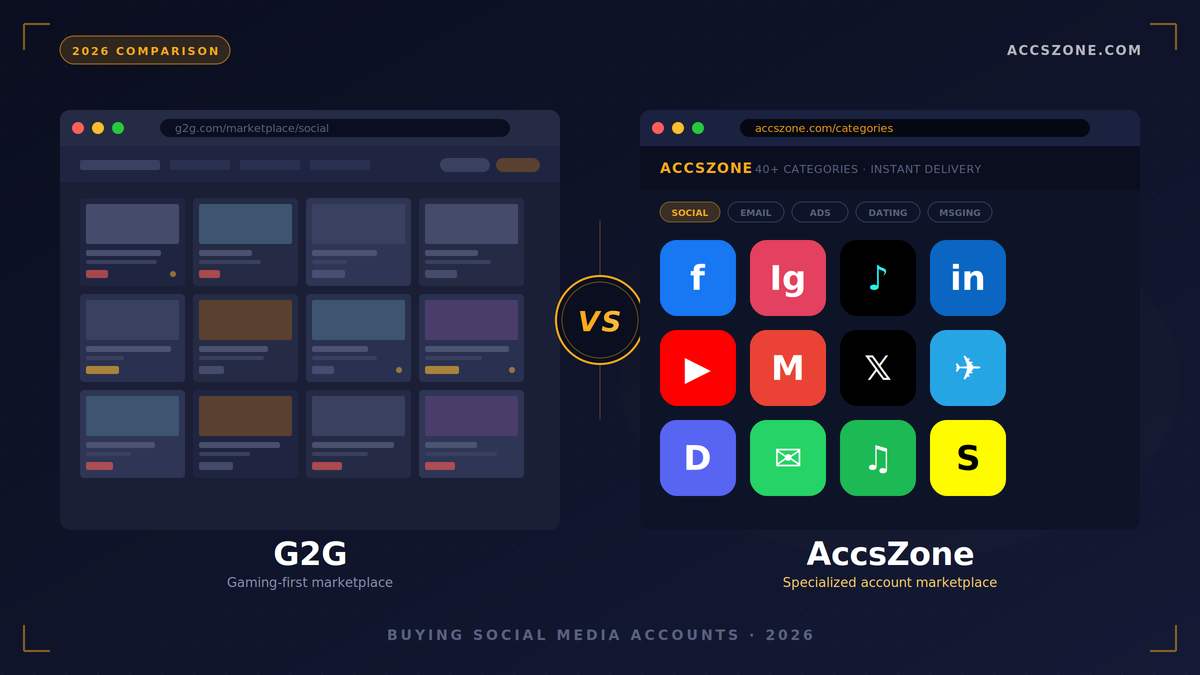
That sounds blunt. The structural reality drives almost every difference you'll feel as a buyer. G2G is a gaming-account marketplace that happens to list social accounts. AccsZone is a specialized digital-account marketplace where social, email, messaging, dating, finance, and ad accounts are the entire product.
This head-to-head walks through eight dimensions that matter to real buyers: delivery speed, account quality, support, replacement policy, filtering, payment infrastructure, and what you actually pay for. We've also flagged where AccsZone falls short, because no comparison is honest without that.
Disclosure: This comparison is published by AccsZone. We've done our best to represent G2G fairly, including pointing out where it genuinely outperforms us.

AccsZone vs G2G at a Glance
| Dimension | G2G | AccsZone |
|---|---|---|
| Primary focus | Gaming accounts and currencies | Social, email, messaging, ads (40+ categories) |
| Marketplace model | Open seller marketplace | Vetted supplier marketplace |
| Delivery model | Mostly seller-chat, mixed automation | Fully automated, instant |
| Average delivery latency | Minutes to hours | Seconds to minutes |
| Filtering for social accounts | Generic e-commerce filters | Niche-specific (age, country, niche, recovery, 2FA) |
| Support specialization | Generalist platform support | 24/7 social-account-trained team |
| Replacement | Per-seller; varies | Platform-level first-login replacement |
| Payments | Multiple incl. some crypto | Cryptomus-first plus alternatives |
| Best for | Game accounts and currency trades | Social, email, ads, and bulk digital accounts |
That table is the headline. The rest of this post is the evidence behind each row, plus the honest cons, plus a routing section that tells you which platform actually fits your use case.
What G2G and AccsZone Really Are
G2G in One Paragraph
G2G launched as a marketplace for game accounts, in-game currency, and boosting services. That's still its center of gravity. Visit the homepage and you'll see it immediately: MMOs, mobile games, currency trades, power-leveling. The social-media-accounts category exists, but it sits alongside thousands of game listings inside an infrastructure built for game-account commerce. Anyone can register as a seller. G2G runs the escrow and dispute layer; sellers handle their own listings, their own delivery, and their own customer interaction.
AccsZone was built in 2023 specifically for digital accounts: 40+ categories spanning social media, email (including aged Gmail going back to 2010), messaging platforms, dating apps, finance accounts, ad accounts in multiple countries, entertainment subscriptions, and infrastructure services like VPS and proxy. Suppliers are vetted before they can list. Delivery is automated end-to-end. You pay, you get credentials, you log in. There's no seller chat to wait through. Sister property AccsBulk handles high-volume orders.

The difference between "marketplace where you can find social accounts" and "marketplace built for social accounts" sounds like a slogan. It isn't. It changes the actual purchase experience in eight specific ways.
1. Marketplace Structure
G2G operates an open seller marketplace. Anyone can sign up, post listings, and start selling. The platform's value to buyers comes from escrow protection and a public seller-rating system. Quality control happens reactively: a seller with bad reviews gets pushed down rankings and may eventually be banned, but the floor for new sellers is low.
AccsZone runs a curated supplier marketplace. Suppliers go through onboarding before they can list. The 50% commission split aligns incentives: suppliers who deliver bad accounts lose access to a steady distribution channel, not just a single sale.
In practice, this matters most when you buy from a seller you haven't bought from before. On G2G, that's a coin-flip on quality, latency, and post-sale responsiveness. On AccsZone, every supplier you encounter has already cleared platform-level vetting.
That doesn't mean every AccsZone purchase is perfect. It means the variance band is narrower.
2. Account Quality and Consistency for Social Media Accounts
This is where the structural difference shows up hardest.
On G2G, "Facebook accounts" or "Instagram accounts" listings are heterogeneous. One seller posts 2018 Facebook accounts with verified phone numbers, US IPs, and recovery emails. The next listing down is 2024 accounts created in bulk last week with no recovery configured. They're filed under the same category. Both look the same in search results until you read every listing description carefully.
The consequence: buyers spend time auditing listings instead of buying. And when an account dies after first login, the dispute process depends on the individual seller's cooperation.
AccsZone's listings are standardized at the platform level. Account age is verified, not seller-claimed. Recovery configuration is documented. 2FA status is filterable. When a Gmail listing says "aged 2014" the supplier had to demonstrate it during onboarding, and the platform enforces consistency across that supplier's inventory.
Buyers we work with regularly tell us the quality variance, not the price, is what eventually pushed them off G2G for social accounts.
3. Delivery Speed and Automation
Fastest difference to demonstrate. Hardest to fix structurally.
G2G's most common delivery model requires buyer-seller chat after purchase. You pay. You wait for the seller to respond. The seller asks for clarification or sends credentials. Some sellers are online and instant. Some take an hour. Some take six. We've seen Tuesday-night purchases sit until Wednesday morning because the seller was in a different time zone and asleep.
A handful of G2G sellers offer instant delivery, but you have to filter for them specifically, and the inventory is thinner.
AccsZone delivers credentials automatically once payment confirms on Cryptomus or any of the alternative payment rails. No chat. No waiting. Median time from "click pay" to "credentials in your dashboard" is measured in seconds, not minutes, and certainly not hours.
If you're running a campaign, an outreach push, or any kind of operation with a deadline, this is the most operationally significant difference between the two platforms.


4. Filtering and Product-Page UX for Social Accounts
G2G's filters are designed for the marketplace's gaming heritage. Price range, seller rating, delivery time, region. These work for game accounts where the relevant attributes are level, server, character class. They strain when applied to social accounts.
What you actually want to filter for when buying Instagram accounts: account age, niche (fitness, finance, fashion), follower count band, country of original creation, recovery email type, 2FA configuration, profile completeness, posting history. Most of these don't have native filters on G2G. You read listing descriptions and infer.
AccsZone's filters reflect the catalog. Browsing the Instagram listings you can filter by age, country, niche, follower count, recovery type, and 2FA status. Same for Facebook, Gmail, TikTok, and LinkedIn. The filters were built for these products, not retrofitted onto a gaming marketplace.
This sounds like a UX nicety. For bulk buyers it's a workflow multiplier: sort 200 accounts by exact criteria in 30 seconds versus parsing 200 individual descriptions.
5. Payment and Crypto Support
Both platforms support multiple payment methods, including crypto.
G2G accepts a broader range of fiat options through traditional payment processors, which can be useful for buyers who prefer card payments and don't mind the additional KYC and chargeback exposure that comes with them.
AccsZone is crypto-first. The integration runs through Cryptomus and supports BTC, USDT, LTC, and several alternatives. Additional methods exist for buyers who prefer them. For privacy-conscious buyers, and this category overrepresents privacy-conscious buyers, crypto-native payment without forcing a card-payment fallback is a feature, not a limitation.
If you're buying $200 of social accounts and want zero card-statement footprint, AccsZone's payment stack is closer to what you want. If you specifically want to pay with a credit card, G2G has more options.
6. Customer Support
G2G's support is centralized and serves the entire marketplace. The first-line contact for any purchase issue is the seller. If the seller doesn't respond, you escalate to G2G. Resolution depends on the dispute system and the platform's adjudication. Support agents are generalists. They handle game-account disputes and social-account disputes and currency-trade disputes from one queue.
AccsZone runs a 24/7 support team trained specifically on this product category. When you report a Gmail account that won't accept the recovery code, the agent doesn't need a primer on what TOTP is or why an aged account behaves differently from a fresh one. They know.
Specialization shows up in how fast a ticket gets to a useful answer.
7. Refund and Replacement Policy
G2G's replacement policy is per-seller, layered under the platform's dispute framework. You buy from Seller A; Seller A's terms govern your replacement window. If Seller A is gone next week, the platform handles it under its own rules. Outcomes vary.
AccsZone enforces replacement at the platform level. Most categories carry a first-login replacement policy: if the account doesn't log in successfully on first attempt, you get a replacement, no seller-level negotiation required. Specific windows and conditions are documented per category. They vary because a Facebook ad account behaves differently from a Gmail aged 2010, but the floor is platform-enforced, not supplier-discretionary.
This is the single feature that converts G2G refugees most reliably. If you've ever spent two days arguing with a seller about an account that died on first login, you understand why.
8. Pricing and What You Actually Pay For
G2G often appears cheaper at the listing level. Individual sellers race to the bottom, and the lowest floor price is hard to beat.
That price is real. So are the hidden costs.
When you factor in the time spent waiting for delivery, the time spent disputing dead accounts, the time spent vetting unfamiliar sellers, and the rough but real percentage of accounts that fail on first login, the effective price per working account on G2G often climbs above the AccsZone equivalent. Power buyers (agencies running 50+ accounts per campaign, resellers stocking inventory) tend to figure this out within their first 100 orders.
For one-off buyers, G2G's listing prices may genuinely save money. For continuous operations, the math usually flips. This pricing-quality dynamic shows up even more sharply when you compare aged inventory specifically, which we cover in specialized marketplaces vs G2G for aged accounts.
The Four Buyers We Hear From Most
Different buyers feel these structural differences differently. Based on what comes through support tickets and onboarding conversations, four personas dominate.
The one-off campaign buyer
Needs 1–10 accounts for a specific marketing push, a creator collaboration, an outreach experiment. Cares about quality more than catalog depth, and absolutely cares about delivery speed because the campaign is already scheduled. G2G's seller-chat lag is a deal-breaker; this buyer is a clean fit for AccsZone.
The agency operator
Running 50–200 accounts per campaign across multiple clients. Quality variance is the killer here, because dead accounts mid-campaign mean rebuilding warm-up cycles from scratch. Platform-level replacement, niche-aware filtering, and consistent delivery latency aren't conveniences for this buyer; they're operational requirements. AccsBulk is built for this volume tier.
The reseller
Buying inventory to resell, often on storefronts of their own. Margin lives in the gap between sourcing price and selling price. Resellers care about (a) getting volume pricing transparent enough to model their own margins, and (b) replacement guarantees so they're not eating losses on dead inventory their own customers report back. Vetted-supplier marketplaces shift the variance risk off the reseller's books in a way open seller marketplaces don't.
The growth marketer or operator
Continuous buyer, often technical, frequently using accounts in tooling stacks (anti-detect browsers, automation pipelines, multi-IP rotations). Needs predictable account configuration. Filtering by recovery type, 2FA status, and IP-rotation history saves hours per batch. This buyer also values crypto-first checkout because the spending is operational and continuous, and card statements get noisy.
If you recognize yourself in any of these four, the platform recommendation that follows is shaped for that profile.
Pros and Cons
G2G
Pros
- Massive total catalog across all categories
- Strong domain history and platform recognition (mostly from gaming)
- Wider variety of payment methods including more fiat options
- Sometimes lower floor prices on individual listings
- Established escrow and dispute resolution framework
Cons (for social account buyers)
- Delivery latency is unpredictable; seller-chat dependence
- Quality variance across listings
- Filtering not designed for social-account attributes
- Replacement depends on individual seller cooperation
- Support is generalist, not niche-trained
AccsZone
Pros
- Built specifically for social, email, messaging, ads, and digital-service accounts
- Fully automated instant delivery
- Niche-specific filtering (age, country, follower count, 2FA, recovery)
- Platform-level first-login replacement policy
- Crypto-native payment via Cryptomus
- 24/7 support specialized in this product category
- Sister property AccsBulk for high-volume orders
Cons (the honest ones)
- Founded in 2023; younger than legacy competitors with multi-year operating history
- Total catalog across all categories is smaller than G2G's full marketplace, though deeper in social/email/messaging specifically
- Specific 10-year-vintage Gmail listings sometimes appear on older specialized platforms first; we restock continuously but don't always have every vintage on hand
- Crypto-first payment may be a learning curve for buyers used to card-only checkouts
Who Should Buy Where
Buy from G2G if:
- Your primary purchase is game accounts or in-game currency. G2G is the strongest option in that category.
- You need a specific fiat payment method that AccsZone doesn't support.
- You only need one or two accounts and the lowest possible listing price is the only factor.
Buy from AccsZone if:
- You're buying social media, email, messaging, dating, finance, ads, or service accounts.
- Delivery speed matters. Operations with deadlines, time-sensitive campaigns, anything where waiting on a seller's response time isn't acceptable.
- You value standardized quality and platform-enforced replacement over the lowest possible listing price.
- You buy more than 10 accounts at a time, or you buy continuously over weeks and months. Variance compounds; consistency saves money.
- You prefer crypto-native payment without forced card fallbacks.
For continuous operations, agencies running multiple campaigns, or resellers stocking their own storefronts, AccsBulk handles bulk volume with the same supplier base.
If you're also weighing AccsMarket against these two, our three-way comparison for 2026 breaks down all three side-by-side, including where AccsMarket genuinely outperforms AccsZone.
Frequently Asked Questions
Is G2G safe for buying social media accounts?
G2G's escrow protects your payment, so you won't simply lose money on a transaction that fails. Account quality and delivery latency are different questions. Both depend on the individual seller, and both vary widely across the platform. For social media accounts specifically, the seller-marketplace structure produces more variance than a vetted-supplier model.
Why are G2G accounts sometimes cheaper than AccsZone?
Open seller marketplaces produce a race-to-the-bottom on listing prices. Sellers undercut each other to win clicks. The savings show up in headline prices and disappear in delivery delays, replacement disputes, and the percentage of accounts that don't survive first login. Effective price per working account often equalizes.
How fast does AccsZone deliver social media accounts?
Delivery is automated. Once Cryptomus or your alternative payment method confirms the transaction, credentials appear in your dashboard within seconds to a couple of minutes depending on payment confirmation. No seller chat is involved.
Does AccsZone offer a replacement if my account doesn't log in?
Yes. Most categories carry a first-login replacement policy. If the account fails to log in on first attempt, you get a replacement. Specific windows and conditions vary by product category and are documented on each listing.
Can I buy in bulk from AccsZone?
Yes. The main AccsZone storefront supports bulk pricing tiers, and AccsBulk is the sister site optimized for high-volume orders. Resellers, agencies, and growth marketers buying 50+ accounts at a time use AccsBulk for volume pricing and continuous restocking.
What payment methods does AccsZone accept?
Crypto-first via Cryptomus, supporting BTC, USDT, LTC, and several alternatives. Additional payment methods are available for buyers who prefer them. There's no card-payment requirement, which suits buyers who want a clean payment footprint.
What's the difference between AccsZone and AccsMarket?
Both are specialized account marketplaces. AccsMarket has a longer operating history and a deep aged-Gmail catalog from years of inventory. AccsZone covers more total categories (40+) and offers fully automated instant delivery and 24/7 specialized support. Our 2026 three-way comparison breaks all three platforms down side-by-side.
Final Verdict
If you're buying social media accounts in 2026 and value delivery speed, consistent quality, and platform-enforced replacement over the lowest possible listing price, AccsZone is the better fit. G2G remains the stronger choice for game accounts and currency trades, where its infrastructure and seller depth match the use case.
If you want to dig deeper into how specialized marketplaces handle aged accounts specifically, and why aged inventory behaves differently on a vetted-supplier platform than on an open seller marketplace, the aged-accounts breakdown covers it in detail.